Binary
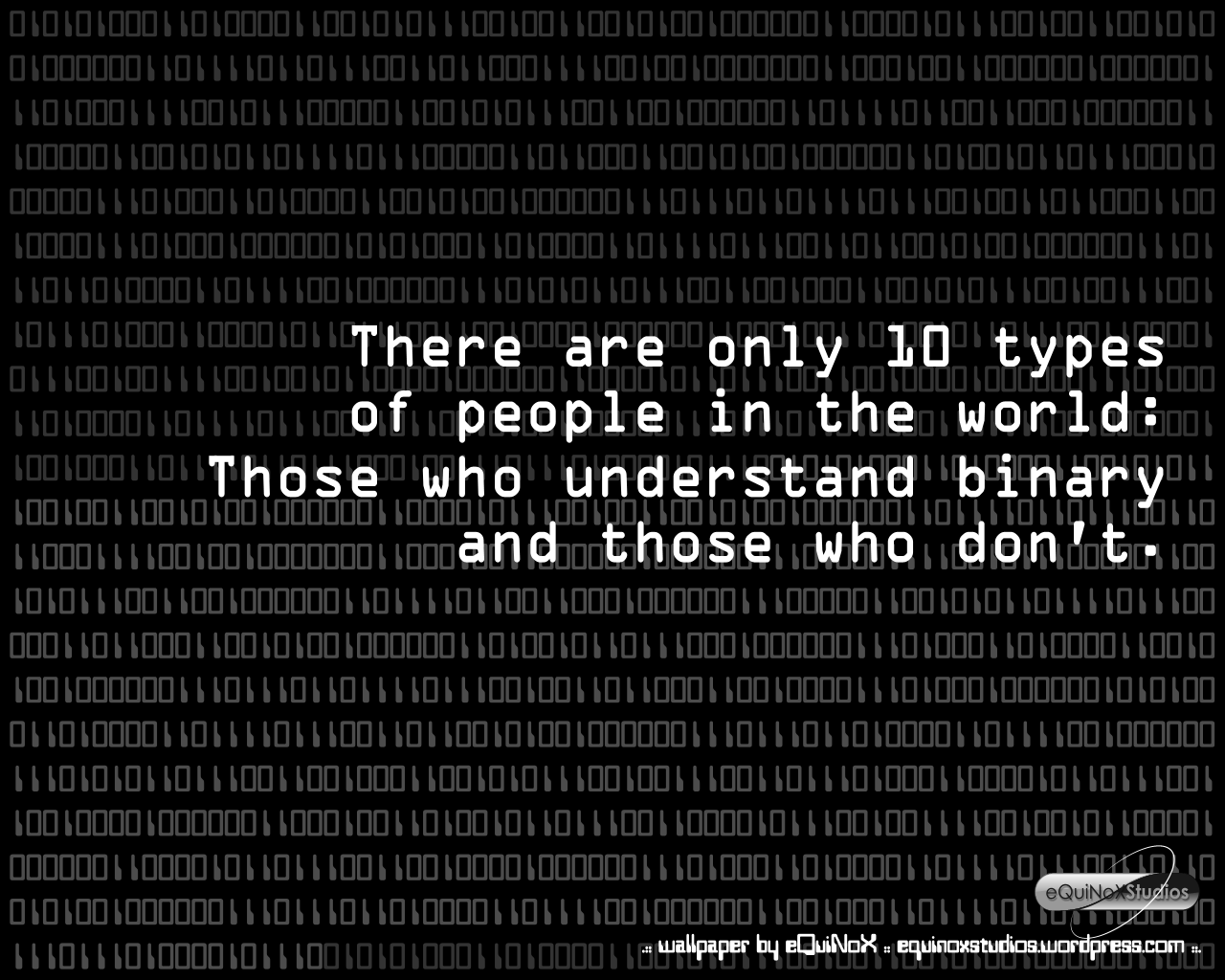
Binary is machine code. In Binary, every digit is represented as either a 1 or a 0. Binary works in multiples of 2.
The digits: 8 4 2 1 represents a nibble. This is 4-bit.
The digits: 128 64 32 16 8 4 2 1 represents a bit. This is 8-bit.
All the digits are represented by either a 1 or 0. For example:
0001 1001 = 25
Because...
128\
|128| 64 | 32 |16 | 8 | 4| 2 | 1 |
| 0 | 0 | 0 |1 |1 |0| 0| 1|
And 16+8+1 = 25
Hex
Instead of working in multiples of 2, Hex works in multiples of 16, it's called Base 16.

ASCII
ASCII stands for American Standard Code for Information Interchange. It is used to represent characters:
- Upper and lower case letters (52 characters)
- All the numeric symbols (10 characters)
- Punctuation and Space (33 characters)
- Non printable code (32 characters)

ASCII stands for American Standard Code for Information Interchange. It is used to represent characters:
- Upper and lower case letters (52 characters)
- All the numeric symbols (10 characters)
- Punctuation and Space (33 characters)
- Non printable code (32 characters)
The http://www.mathsisfun.com/binary-number-system.html
Instruction Set
An instruction set is the instructions used by the CPU to run a program. It tells the CPU what to do.
To run a program, the CPU must go to the start address, from there it decodes its first instructions and finds out what to do next.
Both instructions and data are written in Binary code. The CPU cannot differentiate between the two. If the CPU expects to find instructions, it will find it and decode it.
Examples of Instruction Set
ADD - Add two numbers together.
COMPARE - Compare two numbers.
IN - Input information.
JUMP - Jump to a location in the RAM.
Instruction sets are written in 2 parts: operator and operand.
The operator tells the CPU what to do. The operand gives the location.
The Instruction Set can be embedded in the processor or part of the software.
 Images are stored in binary and are made up of pixels. When representing colour, we use bits per pixel. 1 bit represents two colours:
 With 8 bits, we can represent 256 colours. Colour depth is the number of bits per pixel. To get a better quality image, more bits must be used. That way, more colours can be encoded into the image.
Representation of Images
 Images are stored in binary and are made up of pixels. When representing colour, we use bits per pixel. 1 bit represents two colours:
0 = Black
1 = White
 With 8 bits, we can represent 256 colours. Colour depth is the number of bits per pixel. To get a better quality image, more bits must be used. That way, more colours can be encoded into the image.
Resolution is the number of pixels per unit of measurement. The higher the resolution, the clearer the image will be.
Meta data provides information about an image that the computer can use. Meta data includes:
- The height and width of an image,
- The colour depth,
- The resolution,
- camera used and when the image was taken.
Representation of Sound
Sound is also stored in binary. The computer converts sound (which is continuously varying data) into digital data by sampling the sound wave at regular intervals. The frequency of this is called Sample rate.
How much data is stored per second is called the bit rate. When we store the sound file, the higher the bit rate, the better quality of file. However, this will mean a larger file.
development software
Editor
Programs must be written in an editor, this is like a cut down word processor but it doesn't save your formatting or text for example notepad- on windows or G edit- on Linux. there are some advanced, deemed almost useless editors that grant the amazing perk of... pretty printing. this recognises constructs and put them in different colours :/
Compilers
High level languages look alot like normal English, they are designed to make programming easier, each statement in high level language is turns into machine instructions this makes it easier on the programmer. it is more focused on the programmers intentions than the machine. they are made to convert hihg level language into language the CPU is able to process.
Interpreters
Interpreters are similar to compilers but they do a line at a time and execute as they go. they are great for debugging as they tell you which line had the error when it failed. although it uses more RAM and restricts whoo can run the software to those who have the correct interpreter. It is also slower to translate and run every line. Examples are different versions of basic, just like HAND BASIC on my ipad.
ASSEMBLY LANGUAGE
Assembly Language makes writing machine code programs easier. It uses mnemonics to represent machine operations. It allows the programmer complete control over their code, however it takes longer because of this. Assembly language is unique to the processor that is running it. Assembly language must be converted into machine code by an Assembler.
LINKERS
Linkers allow programs to be built from subprograms. Different parts of programs can be written in different languages with different tools. These are put together by Linkers, literally, linking the separate sub programs together. They also ensure that once the program has been put together, that it runs smoothly

Please check, spelling & grammar, image links and your style formatting across your blog posts. Where is your keywords powtoon?
ReplyDelete